Eco-Score Explained: Complete Guide to A-E Environmental Impact Rating | 2024 Update
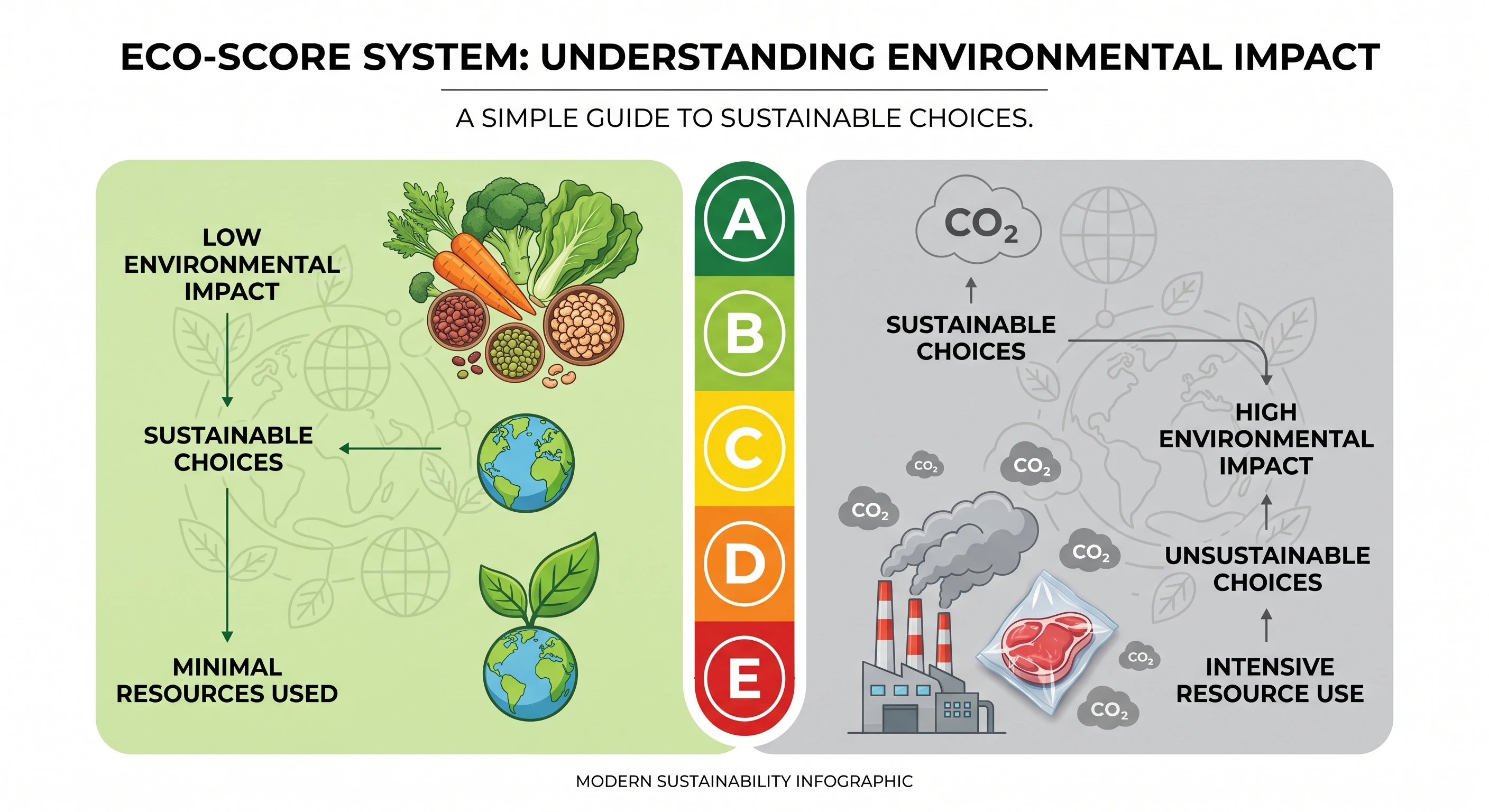
If you want to understand the environmental impact of your food choices, Eco-Score is the tool you need. This five-color label assigns every food product a letter rating from A (best, dark green) to E (worst, red), helping you compare the ecological footprint of similar products at a glance. Launched in France in 2021 by a coalition of digital food platforms, it helps consumers quickly evaluate the environmental cost of what they eat.
Whether you are shopping for packaged meals, dairy products, or beverages, Eco-Score immediately shows which products have a lower environmental impact and which carry a heavier ecological burden. This guide explains everything about the A-E environmental rating system, how it is calculated, and how to use it for greener food choices.
What Is Eco-Score?
Eco-Score is an environmental rating system that summarizes the ecological impact of a food product using a front-of-pack label with a letter and color code. It was launched in March 2021 in France by a consortium of digital food and nutrition platforms including Open Food Facts, Yuka, Marmiton, La Fourche, and others, and is applied on a voluntary basis.
Unlike Nutri-Score, which focuses purely on nutritional quality, Eco-Score evaluates the full life cycle of a product — from agricultural production to packaging and transportation. The score is always calculated per product as sold, making it easy to compare different brands within the same food category.
The A-E Rating System Explained
Eco-Score gives food products one of five classification letters, where A is the best environmental score and E is the worst. Here is a breakdown of what each letter means:
| Letter | Color | Numerical Score | Meaning |
| A | Dark Green | 80 – 100 | Very low environmental impact |
| B | Light Green | 60 – 79 | Low environmental impact |
| C | Yellow | 40 – 59 | Moderate environmental impact |
| D | Orange | 20 – 39 | High environmental impact |
| E | Red | 0 – 19 | Very high environmental impact |
A score of A indicates a product with minimal ecological footprint, while E indicates heavy resource use, high greenhouse gas emissions, and significant ecological damage. However, an E-rated product is not necessarily unsafe — it simply carries a higher environmental cost.
How Eco-Score Is Calculated: 2 Core Components
The Eco-Score combines two major components: a Life Cycle Assessment (LCA) base score and a set of bonus/penalty adjustments for additional environmental factors.
Component 1: Life Cycle Assessment (LCA)
The LCA forms the foundation of the Eco-Score. It evaluates the product's environmental impact across its entire life cycle using the methodology developed by ADEME (the French Agency for Ecological Transition) and is based on the agribalyse database. It accounts for:
- Greenhouse gas emissions — CO₂ equivalent produced from farm to shelf
- Water consumption — liters of water used during production
- Biodiversity impact — effects on land use and ecosystems
- Resource depletion — use of fossil fuels and minerals
- Pollution — soil, water, and air pollution from agriculture and processing
The LCA produces a base score out of 100, where 100 represents no environmental impact and 0 represents the maximum negative impact.
Component 2: Bonus and Penalty Adjustments
On top of the LCA base score, Eco-Score applies modifiers based on factors that the life cycle assessment doesn't fully capture:
- Threatened species (bonus) — products avoiding ingredients linked to deforestation or species loss score higher
- Eco-certifications (bonus) — organic certification (EU Organic, AB), Rainforest Alliance, Fairtrade, etc.
- Packaging (bonus/penalty) — recyclable, reusable, or reduced packaging improves the score; excessive plastic packaging lowers it
- Origins and transportation (bonus/penalty) — locally sourced ingredients reduce the score penalty; long-distance transport raises it
- Policy of the producer country (bonus/penalty) — countries with stronger environmental policies receive a bonus
These adjustments can raise or lower the final score by up to 15 to 20 points, meaning a product with a mediocre LCA score can still achieve a B thanks to strong organic certification and local sourcing.
Eco-Score vs. Nutri-Score: Key Differences
Both use the same A-E letter and color system, but they measure completely different things:
- Nutri-Score measures nutritional quality — what's good or bad for your health
- Eco-Score measures environmental impact — what's good or bad for the planet
- A product can have a high Nutri-Score (healthy) but a low Eco-Score (environmentally costly), such as imported organic salmon
- Conversely, locally grown seasonal vegetables typically score well on both
- They are designed to be displayed together on packaging for a complete picture of a product's overall impact
How to Use Eco-Score for Greener Choices
Like Nutri-Score, Eco-Score is always relative to the product category — an A-rated beef product is environmentally better than an E-rated one, but both will typically score lower than most plant-based alternatives.
Key usage tips:
- Use it to compare similar products — two brands of yogurt, two types of cheese, etc.
- Favor A and B products when given a choice between equivalent options
- Pay attention to the certification bonuses — organic and locally sourced labels improve the Eco-Score
- Use Eco-Score alongside Nutri-Score to make choices that are both healthy and sustainable
- A few D and E products won't destroy the planet, but building habits around A and B choices adds up significantly over time
Which Foods Score Best and Worst?
Food category matters enormously in Eco-Score. Plant-based foods generally score better than animal products due to their lower resource requirements and greenhouse gas emissions.
- Typically A or B — seasonal fruits and vegetables, legumes, whole grains, tap water, plant-based milks
- Typically C — dairy products, eggs, some processed plant-based foods, fish from sustainable sources
- Typically D or E — beef, lamb, some cheeses, out-of-season air-freighted produce, heavily processed meat products
Countries and Platforms Using Eco-Score
Eco-Score adoption is growing, primarily through digital platforms and apps rather than mandatory government labeling:
- France — launched March 2021, adopted by Open Food Facts, Yuka, Marmiton, La Fourche, and others
- Belgium, Germany, Netherlands, Spain — available via Open Food Facts database and partner apps
- Open Food Facts — the open-source food database that powers Eco-Score globally for any product in its database
- Yuka app — displays Eco-Score alongside Nutri-Score for millions of users
- EU Green Deal — the European Commission is working toward a harmonized environmental food labeling standard that Eco-Score is expected to inform
Unlike Nutri-Score, no EU government has yet made Eco-Score mandatory. However, the European Commission's Farm to Fork Strategy aims to establish a standardized environmental food label across all member states by 2030.
Limitations and Important Notes
Eco-Score provides a useful approximation of environmental impact but has important limitations to keep in mind:
- It does not account for animal welfare beyond what is implied by certification labels
- LCA data in the agribalyse database is averaged — individual farm practices vary widely
- Seasonal variation is not always captured — strawberries in winter have a different footprint than summer ones
- It does not measure social impact, such as fair wages for farmers or labor conditions
- Unpackaged or fresh products at markets often lack an assigned Eco-Score entirely
- The methodology is still evolving — scores may change as the agribalyse database is updated
Conclusion
Eco-Score brings environmental transparency to grocery shopping in the same intuitive way Nutri-Score does for health. By combining a rigorous life cycle assessment with bonus adjustments for certifications, packaging, and origin, it gives consumers a single actionable letter that summarizes a product's planetary footprint.
While sticking exclusively to A and B ratings isn't always practical, using Eco-Score to compare similar products — especially in high-impact categories like meat and dairy — can meaningfully reduce your diet's environmental footprint. Used alongside Nutri-Score, it empowers truly informed food choices that are good for both you and the planet.
SEO Metadata Summary
| Element | Value |
| SEO Title | Eco-Score Explained: Complete Guide to A-E Environmental Food Rating | 2024 Update |
| Meta Title | Eco-Score Explained: A-E Environmental Food Rating Guide 2024 |
| Meta Description | Learn how Eco-Score works: the A-E environmental rating system, life cycle assessment, bonus factors for packaging and certifications, and how to use it for greener food choices. Updated 2024. |
| Category | Health & Nutrition / Sustainability |
| Tags | eco-score, environmental food rating, sustainable eating, food labeling, carbon footprint food, green diet, ecology, nutrition education |
Image Generation Prompts
Featured Image Prompt
Create a clean, modern infographic showing the Eco-Score system: a vertical color scale from dark green (A) at top to red (E) at bottom, with letters A-B-C-D-E clearly visible. Include imagery of the planet Earth, green leaves, and renewable energy on the green A side, and factory smoke, plastic packaging, and deforestation icons on the red E side. Professional sustainability/informational style, white background, high contrast for readability.
Featured Image Alt Text
Eco-Score A-E rating system infographic showing color scale from dark green (best) to red (worst) for food environmental impact
In-Content Image Prompt
Realistic photo of various food packages on a supermarket shelf showing Eco-Score labels: fresh vegetables and legumes with green A labels, dairy products with yellow C labels, and packaged meat products with orange D or red E labels. Natural supermarket lighting, clear visibility of the color-coded letter labels alongside Nutri-Score badges.
In-Content Image Alt Text
Supermarket food packages displaying different Eco-Score ratings from A (green) to E (red) showing environmental impact on packaging
References
2. Eco-Score: The environmental impact of food products - Open Food Facts
3. Agribalyse Database - ADEME
4. ADEME - French Agency for Ecological Transition